
Showing posts with label AirWar: C21. Show all posts

Wednesday, July 27, 2022

First Air Battle Over the Leek-Leek

At 0600 hours, reports were coming in that Aquor-Ornur jets were flying over the region of the Leek-Leek National Forest. The commander of Sardeese AFB, which represents the Symbalian western military district, quickly scrambled the only combat-capable squadron still at the base, the 6th Squadron. The 4th and 5th squadrons, consisting of F-16s, were very recently transferred east. It was up to the 6th Squadron to take on the aggressors. Unfortunately, 6th Squadron consisted of the Hawk 200 fighter. These are light, multi-role fighters have yet to be tested in air combat. By 0700 hours, the 6th Squadron was heading to the border to defend Symbalian air space. 


The Match Up
Aquor-Ornur now has two types of fighters: the F5A Tiger II, and Saab JAS 39 Gripen. The Gripen is a more recent acquisition from Northern Chalupistan. The more veteran pilots as well as hired mercenary pilots fly the Gripens. The old Tiger IIs are flow by less experienced pilots. I rolled a D6 with a 50% chance of the Symbalians intercepting either. They rolled the Tiger IIs.  Rules used for this battle: AirWar: C21 with the ranges cut in half to accommodate my kitchen table.

Symbalian Hawk 200 light fighters.

Aquor-Ornur F5E Tiger IIs. These are painted in
Southern Chalupastan colors, but Aquor-Ornur's 
paint scheme is close enough.

The Tiger IIs have the advantage over the Hawk 200s.  They are faster and have a higher power rating than the Hawk 200. The Hawk 200 has a modern radar system and can carry four AA missiles, rather than two on the Tiger II. Both sides carried the AIM-9P3 Sidewinder missile. This is an all-aspect, heat-seeking missile. To compensate for the shortcomings of the Hawk 200, I gave the Symbalian squadron one pilot rated Good (the flight leader), and the two others rated as Average. The Aquor-Ornurians had one Average pilot (flight leader) and two pilots rated Poor. 


The Battle

Turn 1 
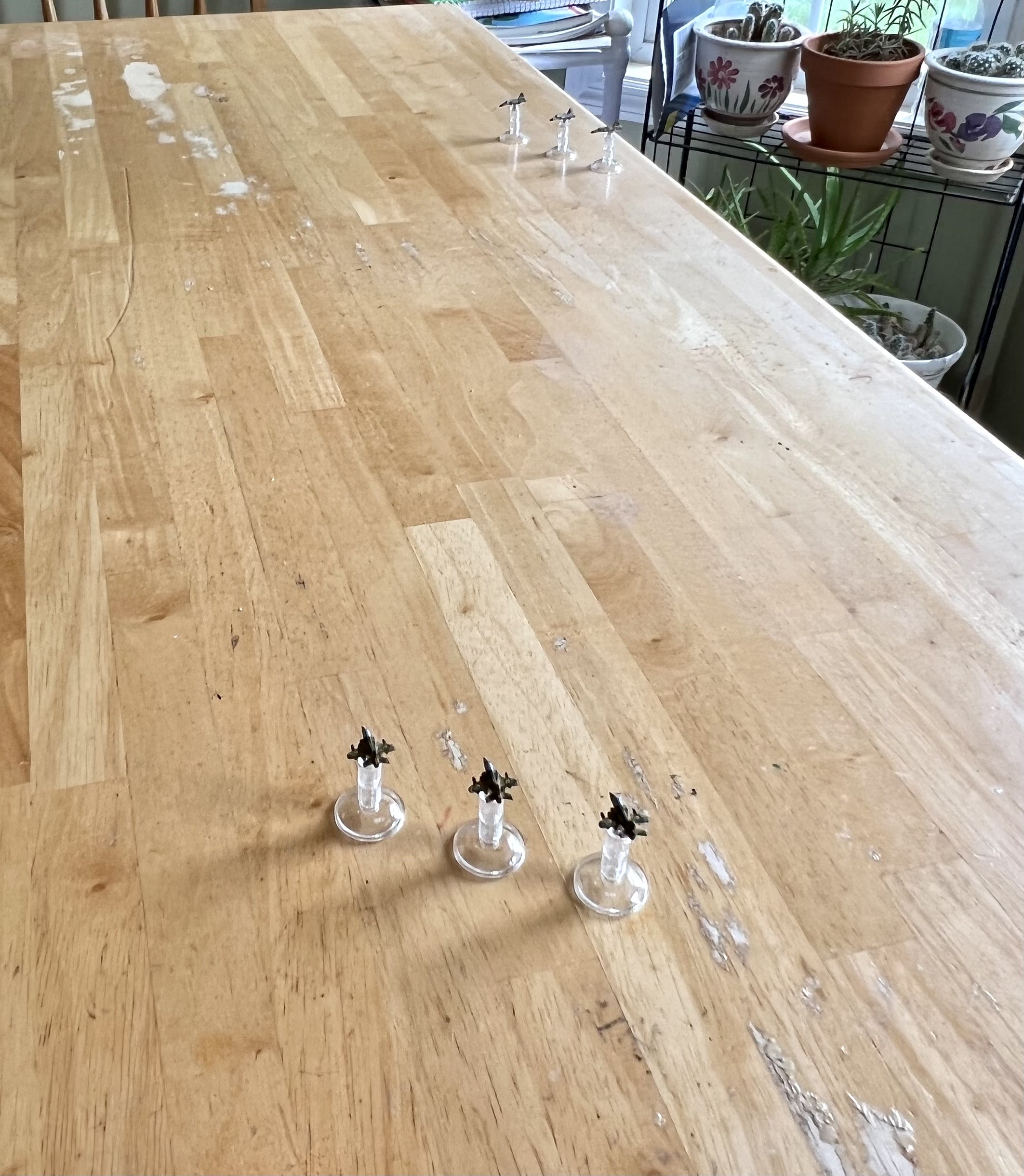
Looking from the east. The F5Es can just be seen
at the upper right edge of the table.

I rolled for where the two squadrons would enter from.  Aquor-Ornurians (abbreviated A-O for now on) entered the board from the north. The Symbalians came in from the east and had the advantage of the sun behind them They hoped that would add to their favor. Their better radar picked up on the A-Os first and they increased speed to try to catch them at their beam. The A-Os, still unaware of the Symbalians, maintained their course and cruising speed. 

Turn 2

The A-Os spotted the Symbalians, increased speed to maximum, and changed course to intercept. Both closed in.

Turn 3
Getting near weapons range, both sides started maneuvering to get behind each other. One of the Symbalians successfully performed a Barrel Roll, while another did a simple turn. The flight leader tried to execute a Barrel Roll and Turn that would have lined him up for a kill:


Despite his pilot rating bonus, the Symbalian flight leader failed. Not only did he find himself in a position he didn’t want to be, he greatly lost speed. Meanwhile, two of the A-O jets split off to the left and right to go after the Symbalians, but the one plane in the center flew straight and ended up almost nose to nose with the Symbalian flight leader:


 The two jets simultaneously fired their guns. Neither one could miss at such close range:

Guns a Blaz'n!!

The Symbalian flight leader gained a bonus damage die whereas the A-O pilot had a reduced number of damage dice due to his poor rating. The amount of hit damage to both fighters was enormous and both planes were destroyed. The Symbalian flight leader, though wounded, managed to successfully eject from this aircraft. The A-O jet was obliterated with no chance of the young pilot surviving. 

Turn 4
Both sides successfully passed a morale test due to the losses and the battle continued…but only for a short time. One Symbalian failed a Barrel Roll and Turn maneuver. The other Symbalian attempted a Split-S and failed that one: 

The Symbalians can't catch a break when it comes
to complex maneuvers!

The failed Split-S maneuver cost him two points of damage for excess speed. On the other hand, the two remaining A-O pilots, even though they were both rookies, successfully executed an Immelmann and a Break Right Turn respectively. Because of the failed maneuvers, neither Symbalian jets were in a position to fire missiles or guns. The both A-O jets launched a Sidewinder that found their targets, hit, and shot the Hawk 200s out of the sky:


Fortunately, both pilots successfully ejected. Their rescue transponders indicated they were sill in friendly territory. Helicopters were dispatched to pick them up. The two A-O F5Es turned west to head back to base to celebrate their victory and memorialize their fallen comrade. A-O commanders on the ground were satisfied with the outcome. At least for now, attack aircraft and helicopters will be unimpeded in their support of ground troops invading Symbalia!

Postgame Analysis
Chuck Yeager said about air combat, "It's the man, not the machine." This did not seem to apply to the outcome of this battle. I blame the loss of the three Symbalian fighter jets on poor rolls when trying to pass the special maneuvers difficulty ratings. It led all three into harm’s way. The flight leader’s roll was so low that not even his +1 allowed him to execute it and he ended up virtually face to face with his opponent because of the failure. Unlike other rules, pilots have to pass a difficult rating test to successfully execute what they call a special maneuver. AirWar C21 really has some major penalties for not passing the difficulty rating test. Not only do you not end up where you wanted to be but you often lose a lot more speed. On top of that, failures mean the aircraft does not get its particular defensive bonus for that maneuver. It is frustrating, but it does make for some interesting outcomes. I will give another set of rules for the next air combat game. 


Wednesday, February 16, 2022

Another stab at basing aircraft

 I got these clear acrylic bases from Litko by way of Amazon. It was a little tricky making the rod perpendicular to the base in all directions for some of the stands, but I think I managed to pull it off. Instead of magnets, I cut tiny squares of steel bases and glued them on top. It gives a strong hold but not so much as to pull the magnets off of either the plane or the base. Plus, I don't have to worry about polarization. The hexagon bases will be perfect for the AirWar: C21 rules. I've been re-reading them and I think I now understand some things I was fuzzy on in the past.


Sunday, May 22, 2011

AirWar: C21 Second Test Run

I finally managed to squeeze a game with another human being! It was very much a last-minute thing. Late Friday night, my friend called said he had some time Sunday afternoon. I thought, OK, lets have a fantasy battle, but I was swamped with various activities Saturday, so I had no time to come up with any army lists. So today, I whipped out AirWar: C21 and some jets and we had two games. I don't have very large tables at home, so we used centimeters rather than inches for movement and weapon ranges. Sorry, no pictures, but I don't think it would have been all that exciting. They were practice games; not part of the Gambusian campaign.

For the first game, I took an Israeli C-7 Kfir, and he took a Saab Gripen. Once again, it sort of felt like I was playing for the first time. It was pretty fast. His first shot was an AIM-120 radar-guided missile at me. It missed. I tried to get around him, buy using a barrel roll and turn but failed and was turned in a very comprising position. He didn't have to do much maneuvering to get in a second second shot. He failed to lock on to me, but he rolled a natural 10 to hit me. BOOM! He rolled a 12 damage and I was blown to bits.

In the second game, we took two of each of the same jets. This time, one of my Kfirs managed to hit one of his Gripens with a Python 4 IR missile, but I only scored a 1 on damage! The my other plane and his were nose-to-nose and in gun range, but he had the initiative. Rather than using his guns, he fired another AIM-120....poof! My plane took 12 hits. So, I had one left. One the next turn, he managed to get back around me at least enough to let loose another of those radar guided missiles, whereas I couldn't launch one of my missiles at him. Once again, he couldn't lock onto me, but his missile still scored a hit! I took more than half damage. From then on, I did my best to try to avoid him and fly home. I managed to avoid him for three turns, but on the fourth, he had a clear shot lined up on my tail. Just for fun he used a Sidewinder missile. It finished me off no problem.

Some things that we questioned. First, its not clear when you launch a missile and when it hits. There is an implication that in the first phase you lock on the target and the second it hits the target. We were playing that both happens on the same phase. Does it matter? I would think it would matter particularly for any sort of radar-guided missiles. I am not sure. It could be that I overlooked this rule one way or another in the rule book. The second issue is about movement. Do we use full movement each phase or only half the movement each phase? I argued that you use full movement each phase because each phase has a prep segment. My friend felt that only half movement should be used because any loss of speed would be more effective in the second phase. He thought that speed penalties imposed by a doing special maneuvers really didn't have much of an effect on things when you could pretty regain them in the following phase. For the previous issue, the fiddly turning template, my friend thought of a novel solution. He suggested gluing a small circle at the bottom of the bases with the different turn radii on them (see previous link on bases for 1/600 planes). Since the planes are on magnets, you can turn the plane in the direction you want to go. I'll give it a try. It may not be perfect, but it might be better than the turning template I now use. Meanwhile, I still plan to order a hex mat to play on. Even if I don't use the mat for C21, there are other air combat rules that I want to test out and can use it for those.

I still think AirWar: C21 2nd ed. is a very good set of rules. However, I would make a few modifications. First, I would reorganize it some. It seems like I have to do a lot of hunting to find the rules. Second, I'd give more examples. There are some, but they are sort of brief, and only cover certain things. I would have a section where the authors run through a sample game, illustrating the various aspects, even those that might seem rather simple. I'm sure that would add more to the cost of the rule set, but it might be worth it.

Friday, December 18, 2009

Big Gaming Plans for the Holidays

Ahem.....probably not. We go and visit my family up north in Chicago on Sunday. My father isn't doing too well lately, so despite the miserable weather that has just hit us here in eastern Tennessee, we are determined to go. I will probably bring all of my 1/600 aircraft with to have another duel with my nephew against my friend Karl. I will try to make sure that we stick closer to the rules this time. I'm sure Karl will fuss about that!

Dwelling on modern air combat rules, AirWar: C21 in particular, I noticed that in order to successfully target in on an opponent, you have to slow down. That doesn't make sense, does it? Or, are we not following the rules properly? Something that I missed? Well, all the more reason to re-read the rules while in Chicago.

Lately, I've really had the bug to start sculpting. I guess I've had it for awhile but there have been a micro-flurry of postings on a Yahoo sculpting group on 6mm sculpting. It really gave me the bug. But, like everything else, will I find the time? Odds are no. The other night, by 5-year-old daughter asked me what I wanted for Christmas. I told her some time to work on my soldiers. She said that I could, so long as neither she nor my wife were home. Then it was OK.

Wednesday, July 1, 2009

Air Battle


While visiting family in Chicago, I had a jet fighter game using Wessex Games’ AirWar: C21, second edition.

It was my friend Karl vs. my nephew Kyle and me. The night before, Kyle and I had a practice game so that he could have some understanding of the rules. Karl and I had a game but about two years ago using the first edition rules.

The scenario had Karl escorting two, heavily loaded Super Etendard strike fighters with two Saab Gripens. He had to get his Super Etendards to the other side of the table. Our mission was to prevent that. One of his pilots was rated a veteran, the other regular. Kyle and I flew Kfir C7 jets. The jets were armed with the missile listed in the AW: C21 Data Annex. Kyle and I had four heat-seeking missiles apiece, whereas Karl had two heat seekers, plus four radar-guided missiles.

I didn’t take pictures of the game because many of the planes were not painted. It was a complete victory for Karl. He managed to shoot down both of our Kfirs and get his two Super Etendards off the table. A few times we lost opportunities to do some harm to Karl’s planes. For example, early in the game, I could have lined up a good shot at one of Karl’s Super Etendards, but I forgot to slow my speed and over shot the plane. Karl managed to stall one of his planes twice, but we failed to take advantage of that. Kyle managed to hit one of the Super Etendards, but scored only a single hit off of a D10 die roll! Also, I overlooked some things in the rules that might have made a difference. First, I failed to notice the a statement in the rules that says that jets that launch radar-guided missiles need to keep their target in sight once launched. Karl’s became fire-and-forget missiles. Second, we didn’t use the critical hits table, which might have made Kyle’s hit more of a success. Third, we didn’t take advantage of the tailing rule. That might have also made a difference.

It is hard to critique the rules since these are the only other air warfare rules I have played with (I won’t count the old AH Richthofen’s War board game). They are pretty well written, and fairly clear. Things that I missed were more my own fault than anything else. My only criticism is with the turning, and it’s not a biggie. In the first edition, you turned your plane in 60 degree increments (or is it 30? I can’t remember). The more maneuverable your plane, the more 60 degree increments you could turn in a phase. In the second edition, there is a compass-like template with the turn radii labeled. It was a little trickier to make the turns exact. For example, when you are making a 30-degree turn, is your model really turned 30 degrees, or is it 35 degrees, or is it 27 degrees? In other words, there was a little more “slop” to our turns. But, as I said, it was not a big deal...I am not a rules lawyer.

Despite our loss, it was a fun time all around. Next time, I will make up some rules crib sheets for the players that will highlight some of the critical aspects of some of the rules.