Showing posts with label 1/600 Aircraft. Show all posts

Wednesday, July 27, 2022

First Air Battle Over the Leek-Leek

At 0600 hours, reports were coming in that Aquor-Ornur jets were flying over the region of the Leek-Leek National Forest. The commander of Sardeese AFB, which represents the Symbalian western military district, quickly scrambled the only combat-capable squadron still at the base, the 6th Squadron. The 4th and 5th squadrons, consisting of F-16s, were very recently transferred east. It was up to the 6th Squadron to take on the aggressors. Unfortunately, 6th Squadron consisted of the Hawk 200 fighter. These are light, multi-role fighters have yet to be tested in air combat. By 0700 hours, the 6th Squadron was heading to the border to defend Symbalian air space. 


The Match Up
Aquor-Ornur now has two types of fighters: the F5A Tiger II, and Saab JAS 39 Gripen. The Gripen is a more recent acquisition from Northern Chalupistan. The more veteran pilots as well as hired mercenary pilots fly the Gripens. The old Tiger IIs are flow by less experienced pilots. I rolled a D6 with a 50% chance of the Symbalians intercepting either. They rolled the Tiger IIs.  Rules used for this battle: AirWar: C21 with the ranges cut in half to accommodate my kitchen table.

Symbalian Hawk 200 light fighters.

Aquor-Ornur F5E Tiger IIs. These are painted in
Southern Chalupastan colors, but Aquor-Ornur's 
paint scheme is close enough.

The Tiger IIs have the advantage over the Hawk 200s.  They are faster and have a higher power rating than the Hawk 200. The Hawk 200 has a modern radar system and can carry four AA missiles, rather than two on the Tiger II. Both sides carried the AIM-9P3 Sidewinder missile. This is an all-aspect, heat-seeking missile. To compensate for the shortcomings of the Hawk 200, I gave the Symbalian squadron one pilot rated Good (the flight leader), and the two others rated as Average. The Aquor-Ornurians had one Average pilot (flight leader) and two pilots rated Poor. 


The Battle

Turn 1 
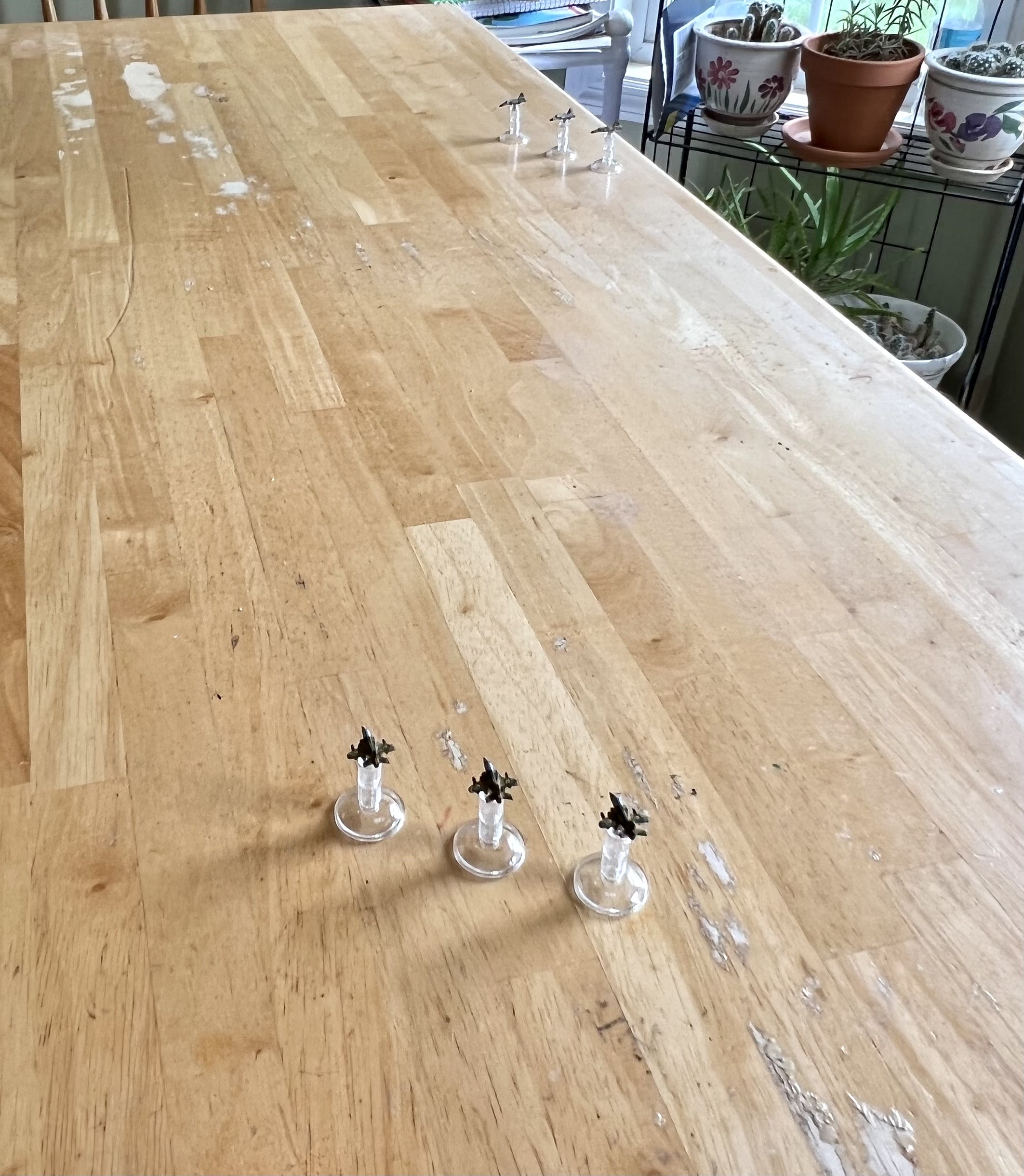
Looking from the east. The F5Es can just be seen
at the upper right edge of the table.

I rolled for where the two squadrons would enter from.  Aquor-Ornurians (abbreviated A-O for now on) entered the board from the north. The Symbalians came in from the east and had the advantage of the sun behind them They hoped that would add to their favor. Their better radar picked up on the A-Os first and they increased speed to try to catch them at their beam. The A-Os, still unaware of the Symbalians, maintained their course and cruising speed. 

Turn 2

The A-Os spotted the Symbalians, increased speed to maximum, and changed course to intercept. Both closed in.

Turn 3
Getting near weapons range, both sides started maneuvering to get behind each other. One of the Symbalians successfully performed a Barrel Roll, while another did a simple turn. The flight leader tried to execute a Barrel Roll and Turn that would have lined him up for a kill:


Despite his pilot rating bonus, the Symbalian flight leader failed. Not only did he find himself in a position he didn’t want to be, he greatly lost speed. Meanwhile, two of the A-O jets split off to the left and right to go after the Symbalians, but the one plane in the center flew straight and ended up almost nose to nose with the Symbalian flight leader:


 The two jets simultaneously fired their guns. Neither one could miss at such close range:

Guns a Blaz'n!!

The Symbalian flight leader gained a bonus damage die whereas the A-O pilot had a reduced number of damage dice due to his poor rating. The amount of hit damage to both fighters was enormous and both planes were destroyed. The Symbalian flight leader, though wounded, managed to successfully eject from this aircraft. The A-O jet was obliterated with no chance of the young pilot surviving. 

Turn 4
Both sides successfully passed a morale test due to the losses and the battle continued…but only for a short time. One Symbalian failed a Barrel Roll and Turn maneuver. The other Symbalian attempted a Split-S and failed that one: 

The Symbalians can't catch a break when it comes
to complex maneuvers!

The failed Split-S maneuver cost him two points of damage for excess speed. On the other hand, the two remaining A-O pilots, even though they were both rookies, successfully executed an Immelmann and a Break Right Turn respectively. Because of the failed maneuvers, neither Symbalian jets were in a position to fire missiles or guns. The both A-O jets launched a Sidewinder that found their targets, hit, and shot the Hawk 200s out of the sky:


Fortunately, both pilots successfully ejected. Their rescue transponders indicated they were sill in friendly territory. Helicopters were dispatched to pick them up. The two A-O F5Es turned west to head back to base to celebrate their victory and memorialize their fallen comrade. A-O commanders on the ground were satisfied with the outcome. At least for now, attack aircraft and helicopters will be unimpeded in their support of ground troops invading Symbalia!

Postgame Analysis
Chuck Yeager said about air combat, "It's the man, not the machine." This did not seem to apply to the outcome of this battle. I blame the loss of the three Symbalian fighter jets on poor rolls when trying to pass the special maneuvers difficulty ratings. It led all three into harm’s way. The flight leader’s roll was so low that not even his +1 allowed him to execute it and he ended up virtually face to face with his opponent because of the failure. Unlike other rules, pilots have to pass a difficult rating test to successfully execute what they call a special maneuver. AirWar C21 really has some major penalties for not passing the difficulty rating test. Not only do you not end up where you wanted to be but you often lose a lot more speed. On top of that, failures mean the aircraft does not get its particular defensive bonus for that maneuver. It is frustrating, but it does make for some interesting outcomes. I will give another set of rules for the next air combat game. 


Wednesday, June 15, 2022

Rules for Interwar Air Combat

 In my previous post, I was putting assembling various aircraft for my ImagiNation interwar campaign The timeline is pretty loose, ranging from the mid-1920s to the late 1930s. I have not had a chance to work beyond gluing wings onto the biplanes, but I have been searching for a suitable rule set. I think I will go with the second edition of Too Fat Lardies' Bag the Hun


I considered Wings at War's Scramble for Britain. I am familiar with their game mechanics, but I would have to make up a lot of the stats for the aircraft I am interested in. Bag the Hun has pretty much all the stats I am interested in and someone on the Bag the Hun Facebook page has filled in the few gaps that there are. It seems a little more complex than I wanted, but I like all the various maneuvers a plane can make. I will need to read it over a bunch of times. I will finally get to use that felt hex gaming mat that I bought a long time ago and have never gotten around to using.


Friday, May 20, 2022

New Project or Crazy Impulse Buy?

 Many, many years ago (late 1980s), I did mini-campaign for my fictional WWII world that pitted the Soviet Union against the UK for a race to take over Iran for its oil resources. It used mainly early war tanks and equipment. I altered the geography such that there was more seaway. That allowed for some naval battles to be fought. I had a map, but its long gone. Also, having read The Great Pacific War by Hector Bywater, my brain got all going to recreate that Iran campaign though set even earlier, and expand it geographically include other foreign nations. I have been slowly building up fleets in 1/6000 scale. 

So, I started buying a bunch of 1/600 aircraft for the air combat portion of it. These guys are from Tumbling Dice Miniatures

Hawker Furies

Polikapov I-15

Henschel Hs 123

Martin B-10

The biplanes were a major pain in the arse to put together. Plus, I only got three fuselages for the Hs 123s. I did get the upper wing and even two sets of landing gear, but not the rest of the fourth plane. 
I also got the Martin B-10 bomber. I've always like slightly archaic weapons and the B-10 especially. I need to figure out what rules to use. I might use Wings at War Battle of Britain rules and make up the stats. I might even try Bag the Hun. Jim over at his Jim's Wargames Workbench has a lot of variants for these rules and I might crib some of his stats for the rules. Unlike my modern air gaming, I am less interested in detailed aircraft stats. 

Wednesday, February 16, 2022

Another stab at basing aircraft

 I got these clear acrylic bases from Litko by way of Amazon. It was a little tricky making the rod perpendicular to the base in all directions for some of the stands, but I think I managed to pull it off. Instead of magnets, I cut tiny squares of steel bases and glued them on top. It gives a strong hold but not so much as to pull the magnets off of either the plane or the base. Plus, I don't have to worry about polarization. The hexagon bases will be perfect for the AirWar: C21 rules. I've been re-reading them and I think I now understand some things I was fuzzy on in the past.


Tuesday, September 14, 2021

Covid hits hard

 Thursday, September 2, my son started coughing a lot, then I did, then my wife did. We all got Covid tests the next day. Everyone was positive except my daughter. Last week was pretty much a wash. My son seems to have recuperated the best and me the worst. I'm still very tired and have this nagging cough. Teaching from home stinks, but a lot of students at my school are starting to come down with it as well. I shudder to think what things would be like for my wife and I if we had not had vaccines. 

Unlike a lot of stories about folks getting hobby projects done, I did not. I did managed to upgrade Aquor-Ornur's airforce. They are now owners of Saab JAS 39 Gripen jet fighters. I had an informal poll on Facebook's ImagiNation group and the Gripen was the winner. In the backstory, Northern Chalupistan was going to sell theirs off to buy some Russian Su-27 fighters. Here they are repainted in Aquor-Ornur's camo scheme:


Not really happy with them, but they will do on the tabletop. Now to work on their opponents.

Sunday, November 29, 2020

The March Toward 3mm War Continues

I managed to get a little hobby time in during Thanksgiving break. I wanted to clean off my bench, at least in terms of figures strewn across the table, so I went back and forth between 15mm fantasy and 1/600 stuff. Its probably been a year now, but I bought a whole mess of 1/600 AFV and infantry from Just Jack. He was running an pretty cool ImagiNation campaign with his son, but it didn't seem to last long. He sold them plus a bunch of WWII minis of the same scale. I've been slowly swapping out the stands to fit in with mine. However, in the spirit of "I want to play a game before I die," I left a bunch on their original stands and flocked some of the ones that still need flocking.

A side track to the side track of my original Gambusia campaign is that the nation of Aquor-Ornur is planning to attack an ally of Lavonia, Symbalia. If you read that original post, they have a tiny army but is funded by and large by the USA. Well, two things, first it got transplanted to the world of Bovatopia and second, its army and airforce grew a lot.

MBTs
They now have three armored battalions. Their front line tanks are the M48A5 sporting a 105mm gun. In the other two battalions are M47 and Sherman Fireflies. 

M48A5 with Sherman Fireflies behind them


APCs
Their main APCs are M1A3 halftracks. I am in the process of painting up some M113s but have not finished them. 


Artillery and Fire Support
The main artillery is some sort of 150 or 155mm field howitzers. I am not sure what they are. They don't seem to be US 155mm howitzers. But I'm not going to be picky. Most rules are not overly finnicky on the type of gun, more on the caliber and type of ammo. 

Just Jack's campaign was over a period time: same nations, different time periods in terms of hardware. So, in addition to the halftracks and the Fireflies, there are a lot of US tank destroyers of WWII vintage. Most of them are M18 Hellcats and a few M10 Wolverines. For some reason, I never liked the Hellcat, but I've got them so, I plan to use them. You can also see in the picture below a towed Bofors 40mm AA gun and a few random trucks.


Attack Helicopters
These weren't a part of Just Jack's collection. I went back and forth between just how advanced A-O's air support would be. I finally on more high tech to offset the low tech ground units. These are actually Chinese Z-10 attack helicopters, but all of these modern attack helicopter look pretty much the same, particularly at 1/600 scale. So, they are supposed to be the Agusta A129 Mangusta. I have had back luck trying to attach the clear rotors that are provided with the models, so I plan to cut out some clear plastic disks and use those.


Source: Aldo Bidini - commons file, CC BY-SA 4.0, https://commons.wikimedia.org/w/index.php?curid=69240249

Infantry
I didn't take any photos of infantry other than the one below. It seems to be a combo heavy weapons-ATGM team. Maybe the machine gunners are supposed to be part of the ATGM team? I have not figured out what the infantry have for LAWs, but I do like these for infantry ATGMs. It might be a Javelin or Dragon, but I'm going to use it as an Israeli Spike MR or LR. Again, at that scale, it can be anything you want it to be.


Source: Natan Flayer - Own work, CC BY-SA 3.0, https://commons.wikimedia.org/w/index.php?curid=5306990

Bonus!
I bought a set of these off of Shapeways. I don't remember who the vendor was. They are the Russian VPK-39273 Volk-3 6x6 APC armed with a 120mm rifled mortar, the 2B17 Nona-K. They are incorporated into the mighty Bovatopian army as much needed artillery support.


Source: Armyrecognition.com January 2014


Thursday, October 29, 2020

Testing a New Method of Flight Stand

 I dread helicopter models for two reasons. First, they are a pain to put together. They always have "fiddly bits" as they say across the Pond that drive me nuts. This is more of a problem with 1/300 models than 1/600 but I have a hard time attaching those clear plastic disks that represent spinning rotors at that scale. Second, attaching a magnet to the bottom of the model is a pain, particularly on 1/600 models. It is bad enough that those rare earth magnets do not stick well, but the helicopter models tend to be either too narrow, and/or have landing gear that interferes with a good attachment. Some time ago, I was grumbling about this in one of my posts (I grumble a lot). Pahoota of The Solipsist Gaming blog recommended using staples as a bridge between the aircraft and the magnetic stand. So, I tried his suggestion:

1/600 Hind with staple stand bridge

 I broke off a block of four staples from a larger block. They are fused together, but I needed to be careful as it is easy to separate one from the rest. It was a little too long to use as is, so I carefully bent them and then cut off the bent piece. Sorry, I don't have a picture to show what I mean but you can see on the part of the staple that is holding onto the magnet where I cut it. I then glued one side to the helicopter with the other end going onto the magnet. So far, it seems to work ok. One advantage of this is that I can paint the helicopter while holding the stand rather than the model. I've been using staples for paper for 1/600 helicopters but I might try heavy-duty staples for 1/300 helicopters. I think it will also work well for very small aircraft. I recently got some 1/600 Pilatus PC-9s, which at that size can pass for either a Super Tucano or an AT-6B. They have very thin fuselages, so the staple bridge might work better than even a narrow cylindrical magnet.  

Saturday, June 20, 2020

Air Strike: Modern Air Combat for the Whole Family! A Brief Review

What a wholesome title for some rules! I previously mentioned these rules. I finally, after much pleading with my 8-year-old son, I played ONE game. I think my hopes for a son who will game with me is shrinking. He's too hung up on Fortnite :(  Red in the Morning blog as a much more detailed review than this.

Basically, you use playing cards to move, turn, fire missiles and guns. Cards are also used to outmanuever enemy missiles. You are dealt four cards and its a matter of card management because number cards allow you to move and turn, but face cards have the additional bonus to fire missiles and how "accurate" the missile is (how strong your radar lock is?). They also act to defeat the missiles. So, if you have a launched missile that is a Jack and you opponent has a Ace, Queen, or King in his hand, he can use it to defeat the missile. You always play two cards per turn. Once the cards are used, they are discarded and you get to draw two new cards.

There are some quirky aspects of of the game. The main quirk is missile damage. If you get hit by a missile, the card used becomes the damage. The odd thing is that in order to get shot down, you have to be hit with the same face card. In other words, if I got hit by a Jack, I'd have to be hit by another Jack to get shot down. So, it would seem that it is possible to survive at least four times by missiles if your opponent is unable to attack you with the same face card. Another funny thing is the turns. Not a big deal, but you can turn up to 90⁰. What is a bigger deal, and maybe I'm not reading it right, but you can rotate a full 180⁰ without moving. Finally, guns are in the optional rules. Guns have a longer range than the missiles, though missiles can move multiple times and turn to track its target. Unlike missiles, guns will knock out a plane with two hits, the suit of the card doesn't matter.

I wanted to photograph the game with my son, but unfortunately, between his gaming and my my needing the phone for talking and texting work colleagues (I'm taking this pointless online course on how to teach online), my battery was down. The game lasted all of about 15 minutes. There was no limit on the number of missiles we had. There was a lot of maneuvering including some fly-bys. We managed to take several missile hits before he hit me again with the same face card that was in my damage pool. I tried to get him to play again, but he wanted me to have a LEGOs with him.

I would say this is a very good game if you want to play something fast, or if you've got some campaign going and want to quickly resolve any air battles. There are no differences in stats. A jet is a jet. The optional rules contain ones for ground attack aircraft, ECM aircraft, and SAMs. My plan was to play a second battle with the boy using the SA-2 missile site I had finished, but that was a no-go. *SIGH*

I have bunch of ideas for tweaking the rules for a little more granularity. But as Queen Catherine of the Red In The Morning blog said, it may not be a simulation of the hardware, but is a good simulation of the decisions airmen make during combat. You can get this at Wargames Vault for $4.50. Quite the deal!

Tuesday, January 21, 2020

Experimenting with Flight Stands

I've been playing around with some different ways to mount 1/600 aircraft on to stands, and the stands themselves.

I as much as I like rare earth magnets to mount jets, there are some drawbacks to them. First issue I have was when I had a magnet on a model as well as on the stand. I tried really hard to make sure the polarities matched, but I didn't always get that right. Second, it was very hard for me to make sure the magnet was mounted on the model so that it was level. Third, rare earth magnets do not like to stay glued.  I suppose that drilling a hole into the model and inserting the magnet into it might have taken care of at least the second and third issue, however, I don't know if my hole would have been any more level than just gluing the magnet on. So, to solve this for at least some aircraft, I glued a tiny piece of steel the bottom.


Using tin snips, I cut out a tiny piece of metal off of some can top. I pounded it out with a hammer to make sure it was as flat as possible, then I glued it to the model. I did have to slightly file down the spot were I glued on the metal piece, but this model of a Mirage 2000 was pretty flat to begin with. Here is what it looks like on a stand.


The advantages are that I don't have to worry about magnet-to-magnet polarity issues, it is a lot easier to make sure the metal piece is level, and it sticks well to the model. The big drawback is that I cannot use this technique with some models. Many of my helicopters and some jets need the metal to project out beyond the bottom of the model. For example, I have some attack helicopters with weapons slung on either side of the bottom. If I didn't have the small cylinder rare earth magnet projecting out, there would not be a contact with the top of the stand.

The second experiment was the stand itself. If you read two of my posts where I play test some rules, you might have noticed some differences in stands. One stand is my LEGO stands. I like them a lot, but it is somewhat difficult to change altitudes. The second stand was a jury-rigged steel base with 1" cylinder rare earth magnets. These are potentially easier to swap out to show changes in altitude, but they have the annoying effect of being so strong that they will pull other bases to each other if close enough. So here is my an experimental base I've come up with:


The stand is a piece of styrene plastic. On it, I glued a piece of metal. The metal cylinder is not a rare earth magnet, but a 5 mm diameter peg used for shelving brackets. The ends are not perfectly level by any means, but its not horrible. The peg is connected to the base by a small magnet. In turn the jet has a magnet glued to it. The hope is that the magnetic field of the two tiny magnets are not strong enough to drag another stand to it, and the plastic base will provide enough of a buffer zone, so to speak.

If all goes well this week, I plan to have another air combat test game using these stands.

Monday, August 20, 2018

Lavonian Air Force

Left to right: Mirage III (Tumbling Dice), Mirage F1 (Tumbling Dice), Saab 37 Viggen (Oddzal Osmy), Dassault-Dornier Alpha Jet (Tumbling Dice).

They might get Mirage 2000 and Saab JAS 39 Gripen, but this is the lineup for now.

The color scheme is Krylon Camouflage Army Green spray, followed by Vallejo Flat Green for the camo pattern. The speckles are done with Vallejo Golden Olive. The canopies are a light blue. 

The red middle of the roundels is supposed to have a yellow cross. Until I can figure out to to make it that small, it will stay blank. IT seems that I made them a little bigger than the Bovatopian and Northern Calupistan MIG 21's. Those were test runs. Freehand roundels seems to look better than I thought, especially for 1/600 scale.

Thursday, May 17, 2018

Bovatopian Mig-21 Fighters

I painted these Tumbling Dice MIG-21 fighters awhile ago and used them to test some air combat rules. Yesterday, I inducted them into the Bovatopian Air Force.


There was no way I was going to manage making the roundels the way I do for my 1/300 scale aircraft, so I took a very fine point drawing marker, made the best circle I could and then filled it in with paint. Its a hit-or-miss method, but it works for me.


Friday, October 21, 2016

Wings At War: Thud Ridge Play Test and Evaluation

I managed to squeeze in another quick air combat game to test out another set of rules. This time it's Thud Ridge, part of the Wings at War series produced by Tumbling Dice.


Thud Ridge takes place during the Vietnam War. In addition to the rule book, you also get a bunch of Tumbling Dice 1/600 scale jets. A while back, I purchased their air rules covering the Falklands War. I hadn't read that set in a while, but they are identical in mechanics with some particulars to each game setting.

I did say in my previous AAR post that these games were going to pit the MIG 21 against the F5/F5A. When I first read through the rules, I didn't notice that F5 stats were included, so I instead decided to have a match between two opposing MIG 21 forces. Hey, it could happen! Two minor nations both equipped with MIG 21s, or the General tries to depose the Sultan of Northern Chalupistan resulting in a civil war. My friend Karl (a.k.a The General) threatened to do just that several times, but I've managed to hold him off.

Thud ridge has some MIG 21 models, so I painted them up, sort of:

One of these days, I'm going to figure out how to make roundels for 1/600 planes
I couldn't decide how I wanted to paint them, so I made a wash of Future Floor Wax with some India ink and slathered it on. It gave the planes a natural metal look and got into the cracks and panel lines. The photo doesn't do them justice. I was pleased with the result. They faced off against my MIGs that are painted in the official camouflage colors of Northern Chalupistan. For this game, there will be few pictures done in ComicLife. While entertaining, they take too long to make, and the learning curve seems a bit high.

The Battle
The game required aircraft to be on square bases of 30mm a side. All I had were 25mm steel bases, but I figured close enough. This time, I used cylindrical rare-earth magnets to attach the aircraft and to indicate altitude differences. These would prove to be something of a major inconvenience later in the game.

The opposing sides started off at different altitudes. A roll of the die determined that the silver MIGs were an altitude of 4 whereas the camouflage MIGs were at an altitude of 3. The die behind each plane represents its current power level. Different maneuvers cost different amounts of power, so the more power you have, the more you can do things. The die color also indicates which plane is which.


Turn 1
The rules have the Americans always go first, so again, I randomly chose the camo MIGs to go first. Not much happens on the first turn. Both camo MIGs move straight. The silver MIGs break to slow their speed. Both plan to dive the next turn. If they dived under full power, they run the risk of breaking up and crashing.

Turn 2
The camo MIG decide to climb. And climb they did, using up a good chunk of power to do so:

Camo MIGs climbing to meet their enemy. Big drop in power: from 5 to 2.

Seeing how the camo MIGs climbed to meet them, the Green MIG of the silver side flies straight at the black MIG of the camo side. Unfortunately, he stops just short of cannon range, and can't launch his IR missiles because he must be behind his target:


Yellow MIG does go ahead and dives thinking he can get behind white MIG:

Yellow MIG-21 just after his dive. One altitude level lower and back to full power.
With these rules, you don't get to move further on just a dive, but you do pick up power.

Turn 3
The camo MIGs really needed to get their power back up and you get more when you dive as oppose to using a Power action. Both executed a dive with the black MIG diving underneath the green MIG and then making a slight turn after the dive:


Now this is the start of my magnetic stand issues. The planes were getting close enough to each other to where they were pulling together! And these are pretty strong rare-earth magnets that make it even more of a pain.

Sunday, October 9, 2016

Target Locked-On! Play Test and Rules Review

I have sort of came out of my funk. Part of crawling my way back to the top was to give myself permission/space to do something fun for me. A lot time ago, I had planned to play a series of short microarmor games using the same units but using different rules. This would be a way of playtesting various rules. I decided to do the same with modern jet combat rules. I think I have about 16 sets of rules including both hard copy and on pdf. I don't think I can play test all of them, but I'll give it my best shot. I've already played AirWar:C21 a few times, so I will put that one on the bottom of the playtest list.

First off is Target Locked-On! by Rory Crabb.


He has put out several rules including ones for both modern and pre-dreadnought naval. You can find them on Wargames Vault, but the supplements are free on his website.

For all of these test games, I will be using my two favorite protagonists, the MIG-21 and the F-5A/F-5E. They duked it out the first air combat game I played with my friend Karl and I've come to liked them. I played around with ComicLife app for the pictures. The captions within the pictures gave the narrative, whereas the text below each picture is the commentary on the picture.

The Battle
The battle took place on a 2' x 4' foam game mat:

The two sides were at opposite ends of the game mat. In hindsight, I probably could have used only a 2' x 2' playing area.

The colored die behind each plane serves to indicate which plane corresponds with its data sheet and to indicate the current altitude. The altitude range from one to six. The die in front indicates who goes first, second, etc. This is determined by the skill level of each pilot. I made all pilots the same skill level.

I rolled for altitudes. The F-5 group rolled low. This cost them a lot of fuel to gain altitude.

Turn 1


The F-5's, especially the black one, wasted a lot of fuel early in the game trying to reach the MIG-21's altitude. This would force them to really have to think about maneuvers later in the game as all maneuvers except dives use up a lot of fuel. On the other hand, the MIGs just cruised along until they were close enough to dive in and attack the F-5s.

Turn 2
Again, probably could have made the game board smaller. Oh well. A way to remedy that might be to increase the movement increments.

Your maneuver is a freebie, after that, you have to roll versus skill level to execute a maneuver. Planes have a set number of maneuvers. For example, the MIG-21 can execute three per turn; the F-5 can execute four. However, every time you try another maneuver, not only do you have to roll for success versus pilot skill, you subtract 1 from your roll. 

Radar locks are not required to launch missiles, but they improve the chance to hit. Unfortunately, there were a lot of radar lock failures.

I called it a night at the end of turn 2 and resumed the next evening. There was a lot of finger crossing that my son wouldn't get in and disrupt things.

Turn 3

Having four successful maneuvers paid off for the black F-5, or so he hoped. He pretty much left himself open to the white MIG-21 to swing around and attack him, and so he did...

What seemed to come up in the game was that most of the time the planes were too close to use their missiles. Missiles have a minimum range, and each time planes ended up too close to their opponent to use them. So, they resorted to their guns, which missed all the time.


Turn 4

By turn four, it seemed that there wasn't going to be a resolution. The F-5s were running out of fuel. The MIG-21 should have fired his missile at the yellow F-5, but missed the chance.

I thought I'd be fancy and try a split-s. The black F-5 had just enough fuel to pull it off. He did, and it have him some speed to escape.

The consequence of failing a maneuver. The white MIG-21 could have had a chance at firing a missile at the black F-5, but he failed a second turn and was out of the zone. 

I suppose that the yellow F-5 could have tried to attack the white MIG-21, but I gave a quick decision die roll and the yellow pilot decided instead to just leave off the board. He didn't have a whole lot of fuel left either.

Although the two MIG-21s had plenty of fuel, their speed had been greatly reduced. The green MIG tried to gain some speed to catch up to the fleeing black F5, but the pilot figured he wouldn't have gotten within missile range before the F5 left the table. This was because he had really lowered his speed early on but never sped up. Even with a dive, which adds to your speed, wasn't enough to catch up.

Critique of the Rules
OK, now for the critique of them. I have to preface this by saying that first, I only have played a few air combat games such as AirWar: C21, Panzer 8's air combat rules, and AH's Richtofen's War to compare with. I do not claim to be an expert on air warfare games. Second, it could be that I missed something when reading the rules so my criticisms could be invalid. If that is the case, please let me know.

Sequence of Play
Target Locked-On! states there are three phases to each turn:

1. Reaction
2. Activation
3. Morale

Reaction is just deciding when each plane gets to do something. Morale is whether or not a plane remains in play based on things like damage, etc. Activation is when all the action happens: movement, maneuvering, firing weapons and all that good stuff. The problem is that the rules don't say when to do what. Can you shoot first then move/maneuver? Or is it the other way around? Or does everyone move first, then shoot? Based on the order of the reading of the rules, I assumed that each plane moved and maneuvered first, then fired at an opponent. In some cases actions are rather vague.  Attempting a radar lock occurs after you fire guns and before you launch missiles,based on where they were in the rules. I made the decision to attempt a radar lock before a plane moved/maneuvered. That way the pilot can plan his moves better. Another example is that an opposing player can execute an evasive maneuver when it's the target of a missile attack. Does this mean the plane gets to move before it's supposed to? What if the plane already moved? A clarification of what happens when during the activation phase would really help.

I really liked the mechanics of movement and maneuvering themselves, especially the fuel loss and that the pilots have to roll to see if a maneuver succeeds. It made me really think long term, especially for the F-5 jets who wasted a lot of fuel trying to get to the same level as their opponents. It also gave a tactical advantage to the MIG-21s who were at a higher altitude. Having a one to six altitude range made book keeping very simple: just use a D6 to indicate current altitude.

Movement Increments
The movement is in centimeters. It seemed like that was a little too small of an increment. On the other hand, inches may be too large. A good compromise could be 2 cm increments. The maneuver templates seem about that size anyway.

Weapons
Missiles all have a minimum and a maximum range. The problem for the game that I played was that the planes ended up not being able to fire missiles due to the minimum range constraint. The maximum missile ranges for almost all missiles are the same as a gun range.  Missiles do double the damage that guns do, but I am not sure what the advantage missiles have beyond that. I think that making missile ranges longer or gun ranges shorter might might improve the usefulness of missiles. I'd make the minimum missile ranges a little more minimum.

A bigger issue I had was that it seemed awfully hard to either hit or do any damage. Both times, jets firing their guns missed their targets and they were not lousy die rolls; i.e., rolled a one. For fun I rolled a bunch of times on the F-5 firing on the MIG-21. It took four tries before I rolled a hit, but then the hit didn't damage the MIG even with the 4+ roll to do damage.

The last thing I have to say regarding weapons is the type of missile guidance. The missile chart shows the type of guidance each missile has, but it doesn't seem to make a difference in combat, or at least I didn't see it in the rules. In AirWar: C2, the type of guidance does make a difference. It's not a big deal, but why put it into the rules if they are not to be used.

Conclusion
I think Target Locked-On! is a good game. It's worth the money and is becoming more and more supported as the author puts out new aircraft stats. I think it took me about three hours to complete over two nights. Once I got used to how the rules worked, it moved pretty fast. If the author puts out a second edition, my main suggestion is to better clarify the order things take place during the activation phase. It also makes for a pretty good solo game. I didn't use morale, but the pilot data can help make decisions during a solo game.